

Breast Symmetry Surgery: Balancing the Other Breast After Lumpectomy, Mastectomy or Reconstruction

Updated: Oct 3
Breast symmetry surgery is an operation on your healthy breast to make it match the breast that was treated for cancer or rebuilt. After a lumpectomy, a mastectomy or a reconstruction, the two breasts often no longer look the same. The other breast can be made smaller, lifted, made larger or filled with your own fat. It is part of breast cancer care, not a cosmetic extra.

Balancing the other breast completes the result of a lumpectomy, mastectomy or reconstruction.
In this article
What is breast symmetry surgery?
Even an excellent reconstruction rarely gives perfect symmetry on its own. Your healthy breast may look bigger, smaller, higher or lower than the treated side. Doctors call the operation on the other breast “contralateral symmetrisation”. Contralateral simply means the other side. It is also called secondary breast surgery, because it is usually a later step.
Surgeons use four main methods, alone or together: making the breast smaller (reduction), lifting the breast (mastopexy), making it bigger with an implant (augmentation) and adding your own fat (lipofilling). The right method depends on whether your natural breast is larger, lower or smaller than the treated side.
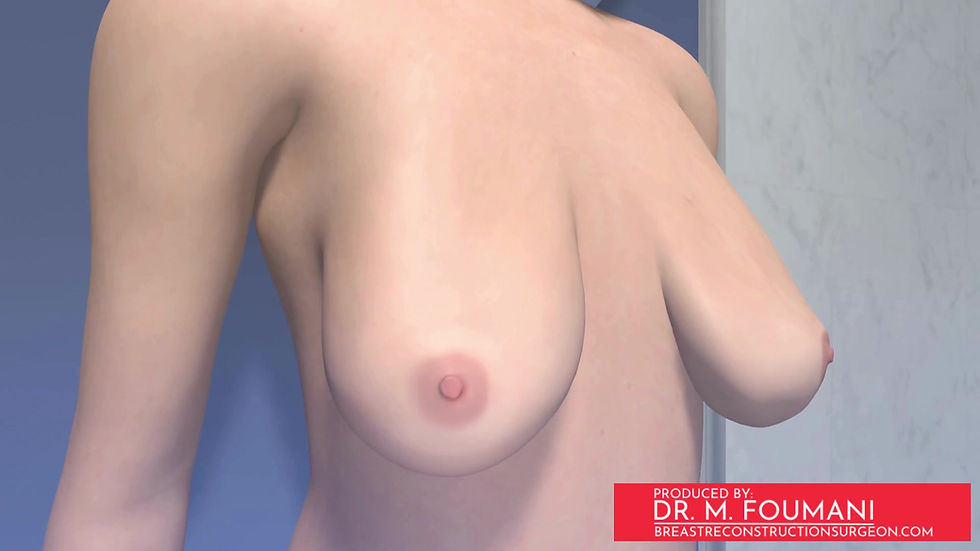
Animation: reduction of the opposite breast to match the reconstructed side.
Breast symmetry surgery after lumpectomy
After a lumpectomy (breast-conserving surgery) and radiotherapy, the treated breast often becomes smaller and firmer over time. It may also sit a little higher. The healthy breast stays soft and may sag with the years. The difference can grow slowly.
The most common fix is a reduction or a lift of the healthy breast to match the treated side. Small dents in the treated breast can be filled with lipofilling at the same time. If the lumpectomy was done with an oncoplastic technique, the surgeon may have already planned the operation on the other breast as a second step.
Surgeons prefer to wait at least six months after the last radiotherapy session. Radiated tissue keeps changing for up to one to two years. Operating on the other breast too soon can bring the imbalance back later.
Breast symmetry surgery after mastectomy and reconstruction
After a mastectomy (removal of the whole breast), the new breast is built with an implant or with your own tissue. The rebuilt breast has its own shape, size and position. It is usually rounder, sits a little higher and does not change with weight or age in the same way as a natural breast.
Symmetry surgery then adjusts the healthy breast to this new shape. Sometimes it is done during the first reconstruction, especially when a reduction on the other side is clearly needed. More often it waits until the rebuilt breast has settled into its final shape. Many surgeons combine it with nipple reconstruction or lipofilling of the rebuilt breast in one final operation.
If you have chosen not to have a reconstruction, a reduction of the remaining breast can still help. A smaller breast is easier to balance with an external prosthesis and gives less strain on the neck and shoulders.
Breast symmetry surgery after implant reconstruction
An implant breast is often firmer, rounder and higher than a natural breast. It has more fullness in the upper part. With a medium-sized implant, the natural breast is often larger and lower. A reduction with a lift of the healthy breast is then the usual choice. This is the situation shown in the animation above.
If the rebuilt breast is larger than the natural one, a small implant can be placed in the healthy breast instead. Because a natural breast sags over time and an implant breast does not, the two sides can slowly drift apart again. A small later adjustment is sometimes needed.
Breast symmetry surgery after DIEP flap
A DIEP flap uses skin and fat from your belly to build a soft, natural breast. Because it is your own tissue, it changes with your weight and ages like a natural breast. This makes long-term symmetry easier than with an implant.
Still, the DIEP breast can be a little smaller or larger than the other side, or sit at a different height. The healthy breast can be reduced or lifted to match. Small differences on the DIEP side are often corrected with lipofilling. This is usually done three to six months after the flap, once the swelling has gone and the new breast has found its final shape.
The options: reduction, lift, augmentation and lipofilling
Making the other breast smaller (reduction)
This is the most common symmetry operation. It is used when your natural breast is larger than the treated one. The surgeon removes extra breast tissue, fat and skin. The remaining tissue is reshaped into a smaller, lifted breast, and the nipple is moved to a higher spot. Most surgeons use the anchor-shaped (Wise) pattern, which gives good control over both size and shape.
Surgeons usually aim for less than half a cup-size difference between the breasts. Many women notice welcome extra benefits too: less neck and shoulder pain, clothes that fit more easily, and no more need for a padded bra.
Lifting the other breast (mastopexy)
A breast lift is the right choice when both breasts are about the same size, but your natural breast sits lower than the treated one. The surgeon removes extra skin, reshapes the tissue and lifts the nipple. The size stays about the same. A small lift may need only a cut around the nipple. A bigger lift uses the full anchor pattern.
Making the other breast bigger (augmentation)
Adding an implant to the natural breast is the least common method. It is used when the rebuilt breast is larger than the natural one and cannot easily be made smaller. Some women also choose it because they want larger breasts overall. The surgeon picks an implant that matches the size, shape and feel of the rebuilt side. If the natural breast also sags, the lift and the implant can be done together (augmentation-mastopexy).
Fine-tuning with your own fat (lipofilling)
Lipofilling means taking fat from your belly or thighs and injecting it where volume is missing. It is used to fill a dent after a lumpectomy, to soften the edge of an implant or to add a little volume to a DIEP breast. It can also add a little fullness to the healthy breast. Part of the fat is absorbed, so more than one session is sometimes needed.
When is the best time for symmetry surgery?
Sometimes symmetry surgery is done during the first reconstruction, especially when both breasts are treated. More often it waits until the rebuilt breast has settled into its final shape.
Most surgeons advise waiting at least 3 to 6 months after the last reconstruction step. After radiotherapy, they advise waiting at least 6 months. Timing matters: radiated tissue keeps changing for up to one to two years. You can also choose to wait much longer. Many women live with their result for a while first, so they know exactly what they would like to improve.
Is symmetry surgery covered by insurance?
In many countries, surgery on the other breast to restore balance after breast cancer counts as part of the cancer treatment. It is then covered in the same way as the reconstruction itself, not as a cosmetic operation. This is the case in the Netherlands, in most of the EU and in the United States.
The rules differ per country, insurer and health system. Some require a referral or approval in advance. Ask your surgeon or hospital what applies to you, and check your coverage before the operation is planned.
Recovery after breast symmetry surgery
Symmetry surgery is usually done under general anaesthesia and takes one to two hours. Most women go home the same day or after one night in hospital. Pain is mild and easy to control with tablets. Most patients return to office work within two to three weeks. You should avoid heavy lifting and hard exercise for about six weeks.
The result keeps improving over several months. Swelling goes down, scars fade and the breast tissue settles. Scars usually fade a lot during the first year, especially if you protect them from the sun and care for the wound well.
Things to consider and the risks
Surgery on a healthy breast is a big decision. Talk these points through with your surgeon:
The change to your healthy breast is permanent, and you will have new scars.
The feeling in your nipple and breast may change. This can be temporary or permanent.
After a reduction or large lift, breastfeeding later may be harder.
There is a small risk (about 3–5% in larger reductions) of losing part of the nipple.
Over the years, the smaller, non-radiated breast may sag more than a firmer radiated or implant breast.
Bleeding, infection and slow wound healing are possible, as after any operation.
Many women feel unsure about having surgery on the healthy breast after all they have been through. These feelings are normal. Talking with women who have already had symmetry surgery often helps. You can find them through support groups.
Frequently asked questions about breast symmetry surgery
What is breast symmetry surgery?
Breast symmetry surgery is an operation on the healthy breast to make it match the breast that was treated for cancer or rebuilt. Doctors also call it symmetrisation or contralateral surgery. The other breast is made smaller, lifted, made larger or filled with your own fat.
Is breast symmetry surgery covered by insurance?
In many countries, surgery on the other breast to restore balance after breast cancer counts as part of the cancer treatment, not as a cosmetic operation. The rules differ per country, insurer and health system. Ask your surgeon and check your coverage before the operation.
How long should I wait after lumpectomy, radiotherapy or reconstruction?
Most surgeons advise waiting 3 to 6 months after the last reconstruction step. After radiotherapy, wait at least 6 months, because the treated breast keeps changing. This gives the treated side time to reach its final shape, so the other breast can be matched well.
Does breast symmetry surgery hurt?
Pain after a reduction, lift or augmentation is usually mild and easy to control with tablets. The first days the breast feels sore and tight. Most women go home the same day or after one night, and return to office work within two to three weeks.
Will I lose nipple sensation?
Some change in feeling is common after a reduction or a large lift. Most women get meaningful feeling back within 6 to 12 months. For some, a small change in sensitivity stays. Modern methods protect the main nerves to the nipple as much as possible.
How visible are the scars?
Symmetry surgery leaves new scars on a breast that had none before. The surgeon places them around the nipple, straight down to the breast fold and, in an anchor pattern, along the fold. They usually fade a lot in the first year but never disappear fully.
Can I have symmetry surgery years after my reconstruction?
Yes. You can have it years after your cancer treatment or reconstruction. Many women choose to wait. They live with their rebuilt breast for a while first, so they know exactly what they would like to improve.
Questions to ask your surgeon
Which method do you advise for my other breast: reduction, lift, augmentation or lipofilling?
When is the best moment, given my radiotherapy and reconstruction?
Where will the scars be, and how will they look after a year?
Can this be combined with nipple reconstruction or lipofilling of the rebuilt breast?
Is this operation covered in my situation?
Related articles
Prepare your next questions
Written by Dr. Mahyar Foumani, plastic and reconstructive surgeon specializing in breast reconstruction. Based on the book 'Breast Reconstruction Explained.'
This article is education, not medical advice
This article explains in plain words how breast reconstruction works. It is meant to help you understand what is possible, so that you and your doctor can make a good decision together. It does not replace personal medical advice.
Every situation is different. What is best for you depends on your body, your illness, your treatment and your own wishes. So always follow the advice of your own doctor or care team. Do you have symptoms, or are you unsure about something? Please contact your doctor or GP. In an emergency, call your local emergency number.
Continue reading


Comments